

The upcoming second Republican presidential primary debate is just around the corner, and GOP candidates face a narrowing window to meet the qualification criteria set by the Republican National Committee (RNC).
To secure a spot in the September 27 debate, candidates must either demonstrate at least 3 percent support in two qualifying national polls or achieve at least 3 percent in one national survey and the same figure in polls from two distinct early voting states, all conducted since August 1.
Candidates must provide evidence of garnering a minimum of 50,000 unique donors to their campaigns. Having met these requirements, candidates must also reaffirm their commitment by signing a pledge to support the party’s eventual 2024 nominee.
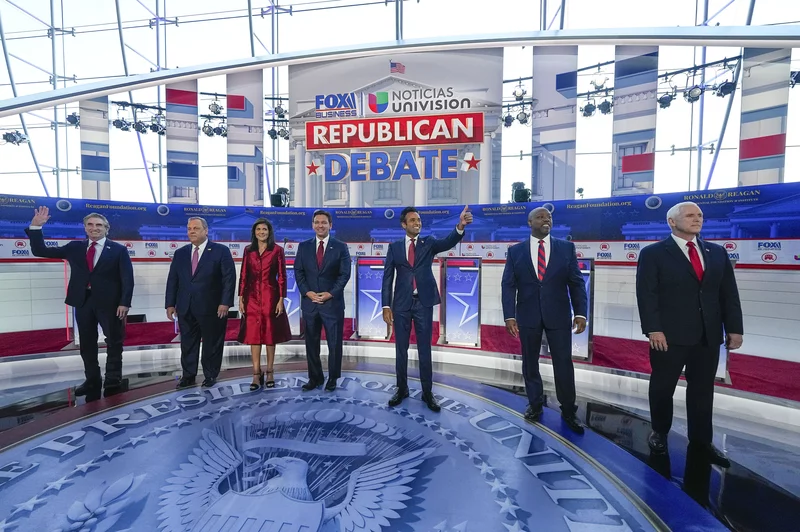
The Second GOP Debate Might See Fewer Participants, Regardless of Trump’s Involvement (Credits: NPR)
As the deadline approaches, it appears that fewer candidates may qualify compared to the eight who participated in the initial debate in August. Six of the previous participants, including Ron DeSantis, Vivek Ramaswamy, Nikki Haley, Mike Pence, Chris Christie, and Tim Scott, seem poised to meet the criteria again, having signed the RNC pledge for the first debate. However, challenges may lie ahead for North Dakota Gov. Doug Burgum and former Arkansas Gov. Asa Hutchinson, who might struggle to meet the heightened thresholds for polls and donors in September. Notably, former President Donald Trump, despite qualifying for the first debate, is expected to skip the second debate.
As of September 13, 2023, six candidates appear likely to qualify for the second GOP debate, based on their polling numbers, donor counts, and adherence to the first debate pledge:
Two candidates, Doug Burgum and Asa Hutchinson, face uncertainties in meeting the qualifying criteria.
An analysis by FiveThirtyEight indicates strong support for the leading candidates, with DeSantis and Ramaswamy consistently polling at or above 3 percent in qualifying surveys. Pence, Haley, and Christie also demonstrate solid support in the majority of surveys, while Scott achieves the threshold in about three-fourths of them. All six candidates have successfully reached the 50,000 donor mark, even Pence’s campaign, which faced challenges in attracting donors.
With 11 days left until the qualification deadline, the primary obstacle for candidates not yet qualified appears to be the polling threshold, which has increased from 1 percent to 3 percent. Burgum, despite meeting the donor requirement, struggles to reach 3 percent in national surveys, while Hutchinson needs both more polls and donors to secure a spot.
The article suggests that candidates such as former Rep. Will Hurd, businessman Perry Johnson, and radio host Larry Elder face considerable challenges in qualifying for the debate due to low polling numbers and, in Hurd’s case, refusal to sign the RNC pledge.
The absence of Trump, polling above 50 percent in FiveThirtyEight’s national average, creates a scenario where the second debate may become a showdown among the leading alternatives within the party. Although Trump’s potential absence may give other contenders an opportunity to shine on the debate stage, it remains to be seen if a strong performance can significantly impact the trajectory of their campaigns.